Atelier – What Caravaggio knew that the rest of us keep forgetting.
There’s a particular moment that happens in a candlelit restaurant – the good kind, where the flames are real, and the tables are close together. You walk in from the brightness outside, and for a few seconds, you can’t quite see. Your eyes adjust. Shapes emerge. The person across from you comes slowly into focus, lit from one side, the other half of their face in shadow.
And somehow, that feels more intimate than any overhead light ever could.
That’s what it feels like to stand in front of a Caravaggio.
At First, You Only See the Darkness
Most people, when they think of Caravaggio – if they think of him at all – remember the darkness. The heavy shadows. The dramatic contrasts. The sense that something urgent is happening just out of frame.
But here’s the thing about that darkness: it isn’t decorative. It’s doing a job.
If you’ve ever shot film photography, you already understand this intuitively. You don’t expose for shadow – you expose for light. The shadows aren’t nothing. They’re what give the light its shape. Without them, everything flattens out into noise. It’s the same reason silence in music isn’t absence. It’s where the meaning lands.
Caravaggio understood this four hundred years before anyone had a word for it. He didn’t paint darkness because he was dramatic (though he was). He painted darkness because he knew exactly – exactly – where he wanted your eye to go.
We live surrounded by brightness, but not always illumination.
The Man Behind the Shadows
Here’s what the textbooks will tell you: Michelangelo Merisi da Caravaggio was born in Milan in 1571, changed the course of Western painting, and died at 38 under circumstances that are still debated.
Here’s what’s more interesting: he was a disaster of a human being who painted some of the most spiritually alive images in history.
He was volatile, restless, and constantly in trouble. He killed a man in Rome – probably over a tennis match, though accounts differ – and spent the last years of his life running. He painted saints who looked like people you’d pass on the street. He used real models: laborers, fishermen, women with rough hands and muddy feet. He gave the Virgin Mary the face of a drowned woman pulled from the Tiber. He gave his apostles dirty fingernails.
The Church commissioned him anyway, because the work was undeniable.
This wasn’t the polished, idealized religious art of the Renaissance (his work falls into the Baroque era). These were people caught mid-breath, mid-decision, mid-miracle. They looked startled because they were startled. That was the point.
Stop and Look
The Cardsharps, c. 1594
Michelangelo Merisi da Caravaggio Oil on canvas · 94.2 × 130.9 cm Kimbell Art Museum, Fort Worth, Texas
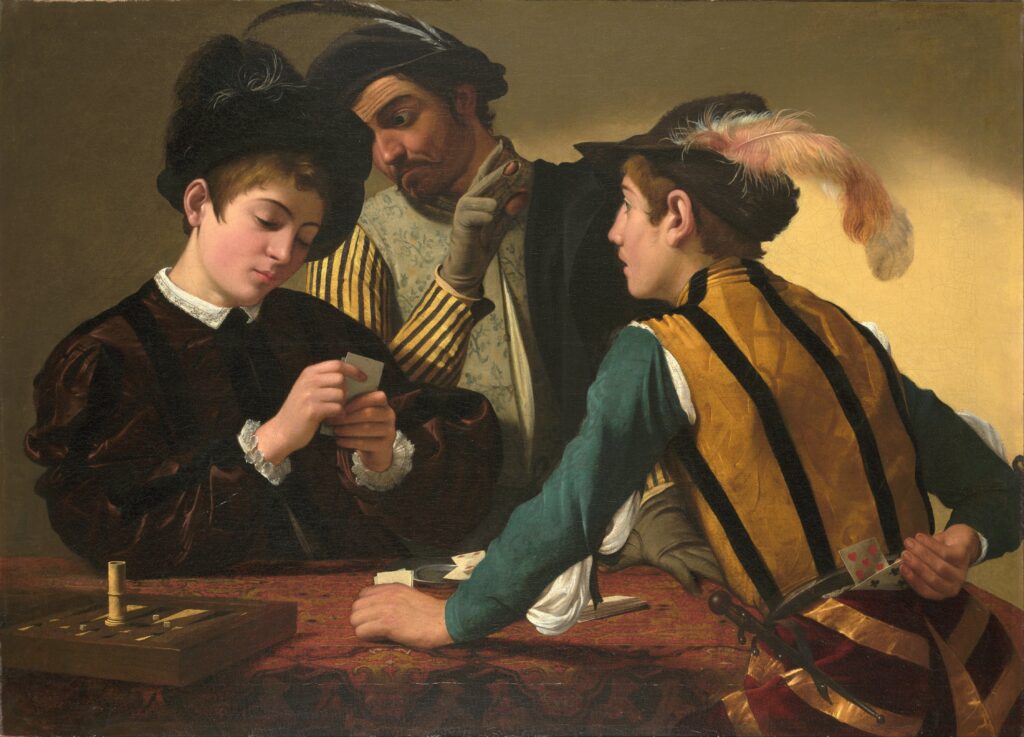
If you live in Fort Worth – or anywhere near it – you have no excuse not to see this one in person.
The Cardsharps is an early Caravaggio, and it doesn’t carry the full weight of his religious work. There’s no saint, no scripture, no miracle. Just three men playing cards in a room, and one of them is being swindled.
Look at the boy on the right first. He’s the mark – young, absorbed in his hand, completely unaware. Now look at the player across from him, the one in the striped doublet. He’s signaling: two fingers behind his back, passing information to the accomplice standing behind the victim. The accomplice is already reaching into his waistband for a hidden card.
You see all of this in a single glance. Caravaggio gives you the whole story – the innocence, the scheme, the moment just before everything goes wrong – without a word of explanation.
The Kimbell is one of the finest small museums in the country, and this painting alone is worth the visit. See it in the afternoon when the light in that building does something extraordinary. I visit it every time I go to the Kimball.
The Calling of Saint Matthew, 1599–1600
Michelangelo Merisi da Caravaggio Oil on canvas · 322 × 340 cm Contarelli Chapel, San Luigi dei Francesi, Rome, Italy
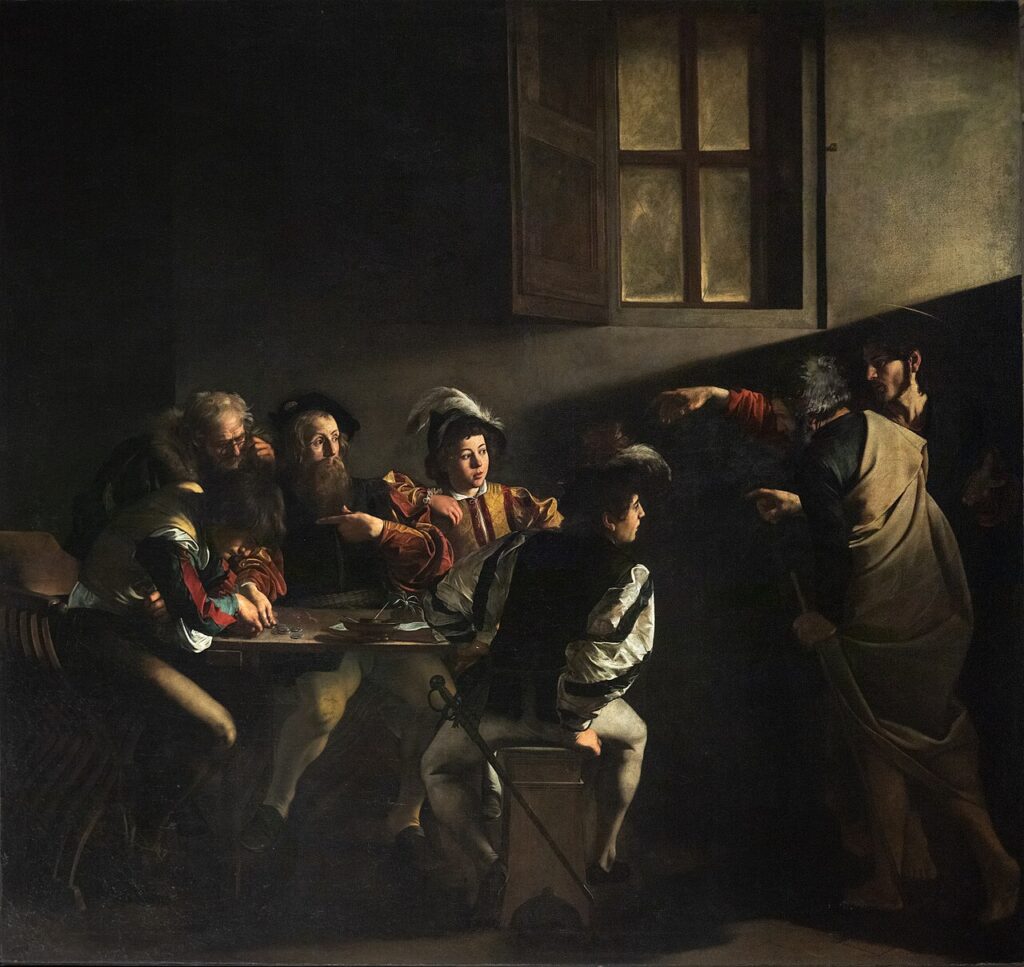
This is the one people travel to Rome specifically to see – and then stand in front of, quietly, longer than they planned.
The scene is from the Gospel of Matthew. Christ enters a tavern (or a tax collector’s office, depending on your reading) and points at Matthew, who is counting coins with a group of men at a table.
Here’s what to notice: the light enters from the right, following the direction of Christ’s outstretched arm. It falls across the faces of each man at the table in sequence, landing finally on Matthew, who points at himself as if to say, me?
Half the men don’t even look up. One is still counting money. Only Matthew sees what’s happening.
The genius isn’t the miracle. It’s the ordinary room. The ordinary men. The way one shaft of light changes everything in an instant, and most of the people in the painting haven’t noticed yet.
Caravaggio painted that scene the same way he painted everything: like it was happening right now, in a room you might actually walk into.
What This Has to Do With Your Life
We are so saturated with light now. Screens in every room. Notifications. Constant, relentless brightness competing for our attention from every direction.
And yet – think about the moments that actually stay with you. The dinner where the conversation ran long, and the candles burned down. The museum room you wandered into by accident and then didn’t leave. The photograph you took that somehow got everything right.
Those moments tend to be smaller. Quieter. Lit from one direction.
There’s a reason a candlelit dinner feels different from eating under fluorescents, even if the food is identical. There’s a reason we still build museums and dim the lights in them. There’s a reason that a 400-year-old painting of men playing cards in a room can stop you cold.
Caravaggio wasn’t painting darkness. He was creating conditions for attention.
And attention – real, unhurried, willing-to-be-surprised attention – is the thing we are most starved for and least willing to slow down enough to practice.
One Last Thing
Once you learn how to look at a Caravaggio, you start noticing light differently everywhere else.
The way a lamp carves someone’s face at a dinner table. The way afternoon sun falls through a window at an angle and makes an ordinary room feel like something worth remembering. The way your eyes, given a moment of darkness, will always find their way to what matters.
Maybe that’s why people still stop in front of these paintings, centuries later, longer than they meant to.
Some things can only be seen slowly.
♥︎ Heather

you said: